Sleep Calculator by Age: Recommended Hours, Cycles, and Lifespan Changes
Human sleep duration and cycle architecture evolve dynamically across the lifespan. Newborns and babies require 12 to 16 hours across short ~50-minute polyphasic cycles dominated by active REM sleep. By adulthood, requirements consolidate into 7 to 9 hours across 90-minute ultradian cycles (5 to 6 cycles). In older adults, slow-wave deep sleep decreases and sleep becomes biphasic or fragmented.
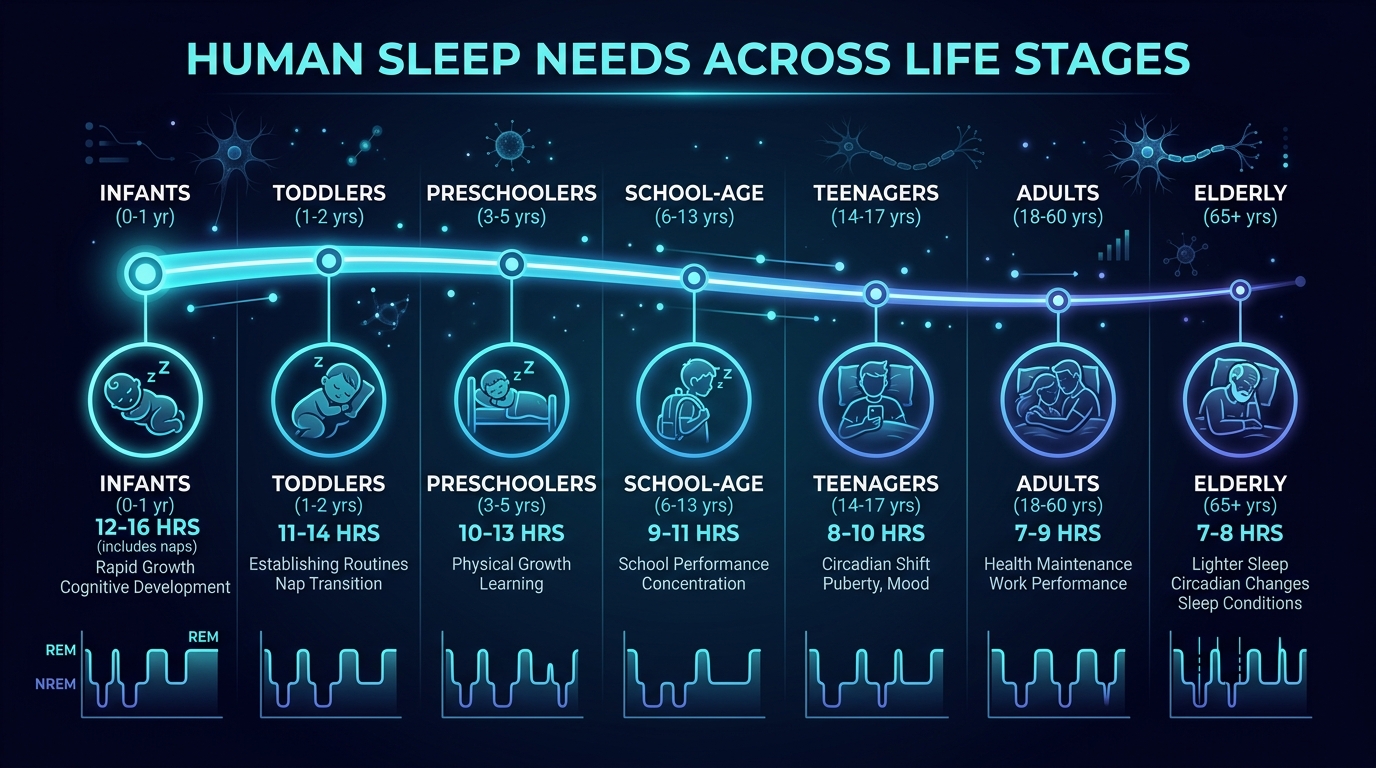
How Sleep Needs Change from Birth to Old Age
Sleep is not a fixed, unchanging biological constant. From infancy to old age, human sleep architecture, cycle duration, and total nightly requirements undergo profound transformations. For deeper context, see our related guides on infant awake windows and sleep routines for children.
While a newborn baby spends up to 16 hours sleeping in polyphasic bursts, a working adult stabilizes around 7 to 9 hours (5 to 6 cycles), and an older adult experiences lighter sleep due to reduced Stage N3 slow-wave sleep.
Complete Clinical Table: Sleep Hours by Age Group
Review the AASM and Sleep Research Society guidelines across developmental stages:
| Life Stage | Age Range | Recommended Sleep | Cycle Length | Primary Focus |
|---|---|---|---|---|
| Newborns | 0–3 mos | 14–17 hours | ~50 min | Brain synaptogenesis & REM (50%) |
| Infants | 4–11 mos | 12–15 hours | ~50–60 min | Motor learning & circadian entrainment |
| Toddlers | 1–2 yrs | 11–14 hours | ~60 min | Language acquisition & memory |
| Preschoolers | 3–5 yrs | 10–13 hours | ~70 min | Growth hormone & social development |
| School-Age | 6–12 yrs | 9–12 hours | ~80–90 min | Cognitive stamina & immune health |
| Teenagers | 13–18 yrs | 8–10 hours | ~90 min | Prefrontal cortex maturation |
| Adults | 18–64 yrs | 7–9 hours (5–6 cycles) | ~90–110 min | Cellular repair & glymphatic clearance |
| Seniors | 65+ yrs | 7–8 hours | ~90 min | Cognitive preservation & cardiovascular rest |
Baby Sleep Calculator: Polyphasic & 50-Minute Cycles
Babies are polyphasic sleepers. Shorter 50-minute cycles allow frequent feeding intervals while providing essential REM sleep for early sensory integration.
By 4 to 6 months of age, nocturnal melatonin ramps up, enabling babies to consolidate longer nighttime stretches.
Sleep Calculator for Kids & Adolescents
During puberty, the pineal gland delays melatonin secretion by roughly 2 hours. This delayed circadian phase preference makes it biologically difficult for teens to sleep before 11:00 PM.
Adult Sleep Calculator (Ages 18–64): 5 vs 6 Cycles
Working adults perform optimally on 5 cycles (7.5 hours) or 6 cycles (9.0 hours). Sleeping 6 hours (4 cycles) can prevent grogginess on high-stress days but builds sleep debt over time.
Elderly Sleep Changes: SWS Decline & Early Waking
Seniors still require 7 to 8 hours of sleep. However, reductions in growth hormone and pineal calcification decrease Stage N3 slow-wave sleep, leading to earlier waking and daytime naps.
Calculate Your Personalized Sleep Schedule
Eliminate guesswork. Use our free, evidence-based sleep calculators to synchronize your alarms with your biology.
Related Sleep by Demographics Guides
Deepen your circadian science and sleep scheduling knowledge with these companion guides:
Frequently Asked Questions
How many hours of sleep does a person need based on age?
Based on AASM consensus guidelines: Infants (4–12 mos) need 12–16 hrs; Toddlers (1–2 yrs) need 11–14 hrs; Preschoolers (3–5 yrs) need 10–13 hrs; School-age (6–12 yrs) need 9–12 hrs; Teenagers (13–18 yrs) need 8–10 hrs; Adults (18–64 yrs) need 7–9 hrs (5 to 6 cycles); Seniors (65+ yrs) need 7–8 hrs.
Do babies have 90-minute sleep cycles?
No. Newborns and infants have shorter sleep cycles of 50 to 60 minutes with 50% REM sleep.
Our editorial research team specializes in sleep chronobiology and circadian rhythm science, translating peer-reviewed polysomnography protocols into accessible digital tools. All sleep models are verified against American Academy of Sleep Medicine (AASM) standards.